







Retailers can often increase profitability significantly without major infrastructure investments by improving the productivity of existing locations. Here's how.
Every business manager should remember two simple sayings:
“You cannot cut your way to growth,” and “If you are not growing, you are going!”
The only way to grow a retail business for the long term is to consistently increase sales and margins while investing in operational improvements that add value. This article will present ways to accomplish these objectives.
Store Locations: One way to increase sales is to capture more traffic by adding store locations. If this investment makes sense and operations can support it, expansion has long been a proven way to scale retail businesses.
The Alternatives: Any independent retailer that doesn’t want to add locations or can’t realistically do so, must also scale revenue because their costs continually increase. When factoring in inflation alone, same-store sales likely need to increase by 3% or more per year just to maintain profitability levels without making cuts.
In the absence of significant sales growth, retailers often turn to cost-cutting. The problem with this strategy is that it is extremely difficult to continually cut expenses while simultaneously growing sales and profitability. In other words, the long-term path for any healthy retail business is clear: grow sales, grow margins, continue to invest, and manage leads/traffic more effectively than competitors.
Retail Performance Overlooked Costs
When businesses attempt to reduce break-even sales levels by cutting costs in order to reach profitability faster, two areas that represent meaningful opportunities for improvement are often overlooked.
"Within the industry, sales per traffic can vary significantly. Among multi-line furniture retailers selling similar products, the difference can exceed $700 per customer visit."
1. Cost of Goods Sold: Cost of goods—including merchandise, freight, and surcharge taxes—is typically the highest accounting-related cost on the P&L.
The Cost of Goods Sold range can vary by up to 12% of sales among retailers with similar product mixes. This means gross margins can differ by approximately $120,000 per million in sales between high and low performers. Organizations that manage margin strategies effectively gain a meaningful advantage in profitability. These differences may be managed by paying attention to various factors, including:
- Increasing protection plan sales
- Creating dynamic pricing strategies
- Being more focused during vendor negotiations
- Applying more disciplined merchandising
- Having a stronger focus on selling higher GMROI products.
2. Cost of Sub-Par Sales per Traffic. The second major cost is economic rather than accounting-related and does not appear on the P&L. It’s the opportunity cost of underperforming sales per retail traffic.
Within the industry, sales per traffic can vary significantly. Among multi-line furniture retailers selling similar products, the difference can exceed $700 per customer visit. This means that two stores selling similar vendors can differ by $700,000 in revenue for every 1,000 store visitors. The difference typically results from productivity variability between organizations. That’s why underperforming stores should focus on the following factors:
- Improving leadership standards
- Installing selling systems and process discipline
- Innovating technology
- Continual sales training
- Expanding and cultivating individual sales talent.
“The Cost of Goods Sold range can vary by up to 12% of sales among retailers with similar product mixes."
A Two Store Comparison
To further illustrate this disparity in sales per traffic, consider the following scenario. Organization “A” operates a store producing $10 million in topline revenue and $1.5 million in bottom-line profit. Organization “B” plans to open a store in a similar marketplace with a nearly identical product mix. Should Organization “B” expect the same results? The answer is: it depends. The outcome will largely depend on whether Organization “B” manages its business similarly with respect to:
- Cost of Goods Sold (margin tactics)
- Sales per Traffic (traffic and selling tactics).
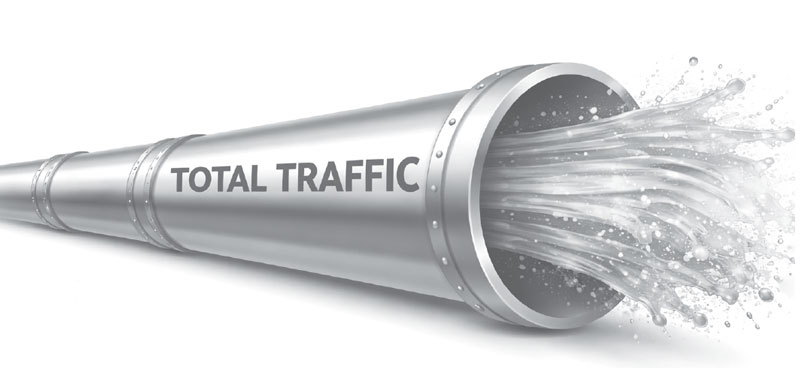
Keep in mind that successful operations span a wide spectrum. Some retailers operate profitably with lower margins and higher traffic productivity, while others succeed with higher margins and lower traffic productivity. Regardless of where your organization falls on that spectrum, one factor that consistently affects profitability is the ability to grow topline revenue.
"Many sales teams rely almost entirely on walk-in traffic rather than actively building their own pipelines."
Holding close rate and average sale constant, revenue growth ultimately comes down to one thing: getting in front of more customers. In other words, generating more traffic that is properly organized and managed, and creating a controllable growth system rather than one that generates randomized outcomes.
The Retail Traffic Growth Formula
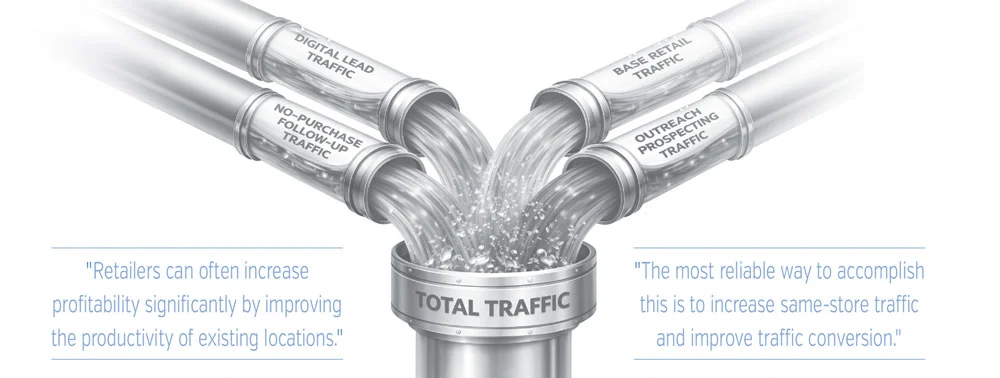
One way to understand this concept is through what I call a Retail Traffic Growth Formula. Retail traffic is not only produced from a single source. It is the result of multiple sources working together to generate opportunities for customers to engage with stores.
Retail Traffic Growth may be separated into the following sources:
- Digital Lead Traffic
- Base Retail Traffic
- No-Purchase Follow-Up Traffic
- Outreach Prospecting Traffic.
The majority of retailers focus primarily on base retail traffic comprised of customers who simply walk through their doors. These operations continually fail to live up to their potential.
Organizations that manage all four sources effectively create more consistent traffic and more predictable revenue growth. The best way to overperform is to recognize that traffic can be organized, influenced, and expanded by creating structured traffic funnels.
Structured Funnels
To illustrate the impact of the Retail Traffic Growth Formula, consider a store that receives 1,000 customer visits per month and produces an average of $700 per visit. That store generates approximately $700,000 in monthly sales. If the organization increases total traffic by just 10%, the store will receive 1,100 visits per month.
Holding close rate and average ticket constant, sales would increase to $770,000 per month, producing an additional $70,000 in revenue. Over a year, that improvement would represent $840,000 in additional sales without adding square footage, inventory, or staff. The key question then becomes: Where does that additional traffic come from?
Organizations that intentionally manage all four funnels—digital leads, base retail traffic, no-purchase follow-up and outreach prospecting—create multiple opportunities to generate that additional growth. Retailers that treat traffic as a measurable system often discover that significant growth can occur without adding stores, simply by improving how traffic is generated and managed.
"Sales would increase to $770,000 per month, producing an additional $70,000 in revenue. Over a year, that improvement would represent $840,000 in additional sales without adding square footage, inventory, or staff."
Traffic Funnels
In a previous Furniture World article titled “Traffic Challenge: The 5-Star Formula—Why It Matters,” the following equation was introduced for retail traffic.
[RT = (TB+TA) + TN +TP + TL ]
RT = Retail Traffic.
TB = Base Traffic (unknown or non-influenced).
TA = Traffic from Advertising = $ spent on advertising x Response Rate.
TN = Traffic Produced from Outreach No-purchase Follow-up = Outreach attempted x Positive touch rate x Appointment show rate.
TP = Traffic Produced from Outreach Prospecting = Outreach attempted x Positive touch rate x Appointment show rate.
TL = Traffic Produced from Non-Store Incoming Leads = Incoming leads x Appointment show rate.
Prior to that, in my article “Funnels and Paths,” which can be found at the same URL, I discussed how grouping customers into segments allows retailers to deliver better experiences through more customized communication and follow-through.
Traffic funnels connect these two concepts. By organizing customer activity into structured funnels, retailers can better manage the traffic sources that generate leads and sales opportunities. This in turn generates lead conversion, more retail traffic, faster scaling and stronger profitability.
Perfecting The Four Funnels
High-performing home furnishings retailers use their knowledge of each of the four traffic funnels to make the most of every customer lead. Here are examples of components that may be included in each funnel, along with actionable steps for maximizing profitability.
Digital Traffic Funnel. This funnel includes leads generated through:
- Website inquiries
- Telephone calls
- Text messages
- Email inquiries
- Social media or digital campaigns.
Organizations that manage digital leads effectively often see significant improvements in lead conversion. Best practices include:
- Recording the opportunity immediately
- Notifying the responsible lead manager
- Conducting a needs assessment
- Determining next steps, such as an appointment or purchase
- Tracking outcomes through CRM systems
- Triggering automated follow-up communication.
Retail (Base) Traffic Funnel. This funnel includes all walk-in traffic influenced by marketing, promotions, or brand awareness campaigns. Once customers enter a store, they move through a selling process that may include:
- Greeting
- Needs assessment
- Product recommendation
- Closing
- Follow-up.
Retailers can attempt to reduce the amount of unknown traffic by tracking marketing influences by using:
- Promotional codes
- QR codes
- Match-back reporting
- Customer journey tracking.
Better visibility into traffic sources improves marketing effectiveness.
No-Purchase Traffic Funnel. Many home furnishings purchases involve customization, complexity, and longer decision cycles. Customers who do not purchase on their first visit often become some of the largest purchasers later. Because of this, prospects who leave without buying deserve structured follow-up.
Organizations that manage follow-up effectively generate additional traffic from returning customers. Effective practices include:
- Agreeing on next steps with the customer
- Using CRM-based follow-up systems
- Sales manager pipeline reviews
- Automated communication reminders
- Tracking be-back percentages.
The Outreach Traffic Funnel. Prospecting is rarely mentioned in the home furnishings industry even though it’s an important part of every professional sales system. Many sales teams rely almost entirely on walk-in traffic rather than actively building their own pipelines. However, top producers consistently reach out to:
- Past customers
- Existing relationships
- Delivery follow-ups
- Room expansion opportunities
- Product accessory opportunities.
Salespeople who maintain strong customer relationships create opportunities that would otherwise never occur. Organizations that encourage outreach prospecting generate additional traffic and future sales.
Conclusion
In many markets, building a new furniture store can cost upwards of $7 million, or involve expensive leases and build-outs. Whether physical expansion makes sense for a particular retailer depends on an organization’s ability to operate new stores profitably and realize long-term value from their real estate investment. However, retailers can often increase profitability significantly without major infrastructure investments by improving the productivity of existing locations. The most reliable way to accomplish this is to increase same-store traffic and improve traffic conversion.
"Customers who do not purchase on their first visit often become some of the largest purchasers later. Prospects who leave without buying deserve structured follow-up."
In the retail furniture business, traffic is not an accident. It is the result of systems, leadership, and disciplined selling processes. Organizations that manage traffic funnels deliberately and consistently outperform those that simply wait for customers to walk through the door.
About David McMahon
David McMahon is founder of PerformNOW Inc. PerformNOW has three main products that help home furnishings businesses improve and innovate: Performance Groups (Owners, Sales managers, Operations), PerformNOW CXM (Customer eXperience Management systems and processes), Furniture business consulting. Your can reach David at [email protected].

See initially published articles by David at Furniture World
Read more
Lean Techniques Part 3: Marketing
Every furniture store needs a strategy for implementing LEAN and applying it to the marketing. Here’s how.
Case Study: Written & Delivered Sales
Attention to written & delivered sales increased annual cash flow more than $100,000 for this average sized retailer.
Measure Gross Margin Return On Inventory
Track this inventory metric to understand your customer’s buying patterns, establish a more relevant product mix, satisfy more people and sell more.