







The goals, metrics, and practices described here are not theoretical. They are what real stores with real teams are doing right now.
For over 10 years, I’ve had the privilege of facilitating semi-annual meetings with some of the best retail sales managers in North America. Their stores are located in different regions, vary in size and serve different market segments. But the themes that emerge are remarkably consistent.
I recently facilitated a multi-day session with 35 managers and leaders, sharing what projects they are working on, what is working, what isn’t, and what they plan to do next. What follows are common themes discussed, valuable practices, driving metrics and insights that emerged. If you are a sales manager or retail owner working in the home furnishings business, there is something here for you.
The Sales Pipeline Becomes a Priority
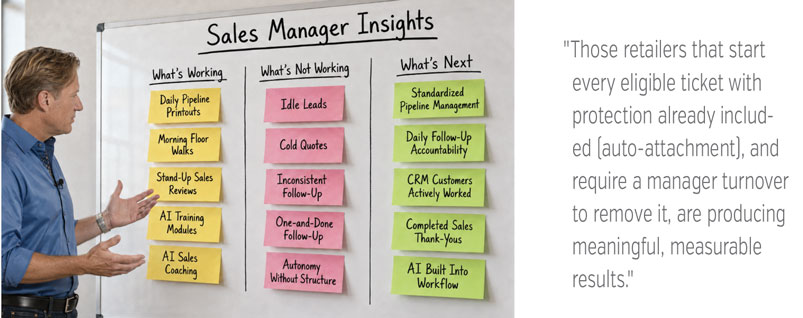
The number-one operational topic discussed was retail sales pipelines — specifically, the lack of structured management for them. Most attendees admitted their teams were decent at recording potential sales but weak at actively working them. Leads were sitting idle. Quotes were going cold. Follow-up was inconsistent.
The underlying problem is accountability. When salespeople have autonomy without structure, follow-up becomes optional rather than standard. A common finding was that nearly half of all salespeople give up after a single follow-up attempt, even though teams with disciplined follow-up practices generate three times more revenue from the same traffic. That gap is enormous. And follow-up is free marketing.
"These managers are tired of making exceptions, tired of chasing follow-up, tired of managing people who've come to believe that inconsistency has no real consequences."
Sales Pipeline Management: The most effective approaches the group cited included daily visual organization of each rep’s pipeline into parts, for example:
- Hot leads recorded into their CRM
- Open quotes with follow-up actions needed
- Completed sales requiring a thank-you.
Those people who required daily accountability in each category changed their behaviors. Revenue from returning customers and pipeline conversion improved. The goal was not to create more work. The goal was to make it impossible to forget a guest.
Several managers shared that they have shifted how they start each day. Morning floor walks and stand-up reviews with sales teams provide visibility into who needs to be contacted and what action is required. When follow-up is discussed in front of peers every morning, it is no longer optional.
AI Moves From Curiosity to Application
A few years ago, AI was something managers read about. Today, these professionals are using it, some in basic ways, others in sophisticated ways. The consensus across the group was clear: AI is not replacing anyone in these stores. It is accelerating what good people can already do.
The most common applications are in training, coaching, and reporting. On the training side, raw discussions about sales processes — how to greet a customer, how to qualify, how to handle objections — are being converted into short, structured video modules that new hires can access on demand. Training in these stores no longer depends on whether a senior rep is available or has the time.
AI For Sales Coaching: There was significant discussion about using AI for sales coaching, allowing reps to practice customer scenarios, receive structured feedback, and build skills outside of live interactions. Managers see this as especially valuable in large-format stores where they cannot be present for every customer interaction on the floor. The ability to review coaching session results and then use them as a basis for one-on-one development conversations is seen as a major advantage.
Performance Reports: On the reporting side, AI is being used to automate individualized performance reports for each salesperson, pulling sales per guest, close rate, average ticket, quote activity, and peer benchmarking directly from POS data. What used to take hours to produce manually is now delivered automatically on a regular cycle. The impact on coaching conversations is immediate. Instead of debating opinions, managers and reps are now discussing real numbers.
AI-Generated Renderings: Room visualization using AI-generated renderings is also gaining traction across the group. Customers can see how furniture will look in their actual space before committing to a purchase. The result is shorter sales cycles, higher close rates among indecisive shoppers, and greater accessory attachment. Thousands of renderings are being produced each month by teams that embrace this approach.
The pattern is clear: Companies that are moving the fastest with AI treat it as a standard part of their workflow, not an experiment. They have assigned usage expectations and are tracking results.
"Many managers target a 37% close rate. Their focus is on building relationships faster, creating appropriate urgency, and converting first-time guests in fewer attempts."
Training Becomes a Serious Focus
Training is one area where managers voiced frustration. Most are operating with informal systems. New hires learn by shadowing experienced reps, a practice sometimes called “freestyle” onboarding. The problem is that not every experienced rep is a good teacher, and even good teachers do not always deliver the same message the same way twice. The result is an inconsistent foundation for every new hire.
The managers voiced that they were committed to changing this situation. Plans were shared to build week-by-week, day-by-day training roadmaps covering the full onboarding period. Multiple trainers will be involved — each covering a specific area of expertise, whether that be furniture, mattresses, financing, systems, or the selling process itself. The goal was to have a consistent, repeatable experience that every new hire goes through regardless of when they were hired or who was available.
Speed to Productivity: Retirements come. Turnover happens. Getting new people up to speed faster is not a luxury; it is a business requirement. When new hires are shown a clear path for day one, day five, and day thirty, they start producing sooner and with greater confidence.
Morning Meeting Training: A related practice discussed is restructuring morning meetings to focus on one or two sales topics per week rather than making general announcements. A ten-week mattress training program was among the examples shared. The thinking is straightforward: when retailers commit to teaching one skill well each week, at the end of the year these 365 new skills learned can make a huge difference in sales and profitability.
An Accountability Culture
A theme that ran through nearly every conversation was accountability, not introduced as a punitive concept, but as a professional standard. Managers were tired of making exceptions, of chasing follow-ups and managing people who have come to believe that inconsistency has no real consequences.
Applying Standards: Across the group, stricter attendance policies, bonus structures tied to specific behaviors, goal attainment, review generation, checklist completion, and metric-based coaching are being implemented. The businesses that put real teeth behind their standards reported significant changes in culture. High performers who had been quietly carrying their teams became more engaged, and complaints from chronic underperformers decreased.
The message in the room was that serious team members want to work for companies that set and enforce standards that are applied equally. When managers enforce expectations without exception, company cultures improve for everyone — not just managers. The top performing companies were not held hostage by individuals with their own standards of conduct.
Metric-Based Dialogue: On the sales floor, accountability is being reinforced through data. Managers are moving away from intuition-based coaching toward metric-based conversations. When a salesperson can see their own numbers compared to peers, there is no ambiguity about where they stand, but there is a clear direction for improvement. The best coaching conversations happen when the numbers are in front of both parties.
Key Metrics Drive Focus
When sales managers are asked to share the most important metrics they’ve tried to improve, their answers tell me a great deal about how well they understand their business. In this meeting, the responses were specific and measurable.
Sales per Guest (SPG): This was the most commonly cited metric. Targets range from $700+ for newer staff to $900 as the store average, to $1,300+ for strong performers. SPG combines average sale and close rate into a single number that reflects how much value a salesperson extracts from each customer interaction. When SPG goes up, revenue goes up without requiring more traffic.
Close rate improvement: A primary goal for many managers is to target the 37% range. Their focus is on building relationships faster, creating appropriate urgency, and converting first-time guests in fewer attempts.
Protection plan attachment (FCP): Attachment rates were on everyone’s radar. Targets range from 3.5% to 5+% of sales. Those retailers that require every eligible ticket to start, not end, with protection are producing meaningful, measurable results.
Mattress attachment: Expressed as a percentage of total sales, mattress attachment was cited as a widely shared goal, pursued through training, promotions, bundling strategies, and, in some cases, dedicated advertising investment.
Productivity score: This measures how consistently salespeople engage customers, follow up on pipeline, and meet daily process expectations. Low productivity scores give managers an early warning to focus on coaching before lagging sales numbers show up. Participants noted that this metric is being tracked with targets of 60%-70%.
Marketing & Promotions
Loyalty promotions: When tied to spending milestones, loyalty promotions produced strong results. Sales increases of over 40% during promotional periods are common, with carryover effects afterward. The consistent lesson shared is that these promotions require prior customer-segmented group marketing, pre-event outreach to these customer groups, and structured follow-up by all individual sales reps, all backed by CRM automation. Without all these elements, maximal results will be unrealized.
Community-based initiatives: Some managers explained that these initiatives, which combine charity events with in-store traffic drivers, produce sales lifts of over 30% during event periods along with meaningful local press coverage. The costs are modest, and the goodwill is lasting. Other managers noted that they are currently exploring how to bring similar programs to their own markets.
The common thread across all prospecting and marketing discussions was measurement. Managers reported what worked, what it cost, and whether they could repeat it.
What Separates the Best From The Rest?
After facilitating groups like these for many years, I’ve developed a fairly reliable sense of what separates operations that consistently perform well from those that struggle. It’s not location or store size, or market conditions. It is leadership, execution and commitment to do fundamental things consistently and well, and then to measure them, improve them and hold teams accountable.
The best managers in the room accepted that there were no shortcuts. You cannot wish your way to a higher SPG. You cannot hope your way to better protection attachment. You need a process, technology, measurement, and follow-through. They also understood that improvement is a continuous discipline, not a project with an end date. The ones who will be performing at the highest level at our next meeting are already executing on what they committed to at this one.
The goals, metrics, and practices described here are not theoretical. They are what real stores with real teams are doing right now.
About David McMahon
David McMahon is founder of PerformNOW Inc. PerformNOW has three main products that help home furnishings businesses improve and innovate: Performance Groups (Owners, Sales managers, Operations), PerformNOW CXM (Customer eXperience Management systems and processes), Furniture business consulting. Your can reach David at [email protected].

See initially published articles by David at Furniture World
Read more
Dealing With Retail Bottlenecks
The difference between operations that run smoothly and those that are chaotic is often the number and severity of operational bottlenecks.
Case Study: Marketing Effectiveness Metrics
Retailer “A” has a bigger ad budget. Retailer “B” uses more digital media. Which one gets better returns?
Traffic Challenge: The Five-Star Formula—Why It Matters
Boost furniture sales and profits with David McMahon’s Five-Star Formula—an expanded traffic metric covering ads, follow-ups, prospecting, and lead strategies.